 Skip to content

The Economics of Creative Industries in Canada – From Theatre Grants to Game Studios
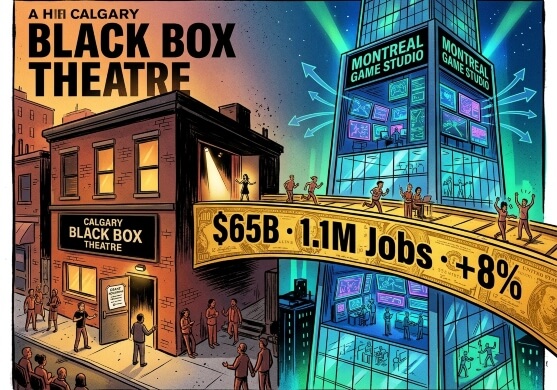
$65 billion. That’s what Canada’s arts and culture sector contributed directly to GDP in 2024, according to a 2025 report by the Canadian Chamber of Commerce’s Business Data Lab. Factor in the supply chain and employee spending, and the total impact doubles to $131 billion. The sector supports 1.1 million jobs. It grew 8% over three years – twice the pace of Canada’s overall economy.
Those numbers cover everything from a 50-seat theatre company in Calgary running on $175,000 in annual grants to a Montreal game studio pulling in nine-figure revenue from global exports. The range is extreme. But the economics of creativity in Canada tie these worlds together in ways that aren’t always obvious.
How Cultural Organizations Actually Get Funded
The Canada Council for the Arts is the largest single source of public funding for the arts in Canada. The federal government doubled its budget between 2016 and 2021, putting in $1.1 billion in new money over that period. In 2024–25, the Council funded more than 3,000 individual artists, 390 groups, and 1,950 arts organizations across the country.
That sounds like a lot until you look at the math. The Council’s annual budget sits around $360 million. Split that across every theatre company, dance troupe, literary magazine, music collective, and visual artist in the country, and the per-recipient numbers get thin fast. Budget 2025 spared the Council from the 15% spending cuts applied to other federal agencies. That was treated as good news. The Canadian Arts Coalition has been asking for a $140 million increase. They haven’t gotten it.
Provincial and municipal grants add another layer. In Calgary, for example, Calgary Arts Development runs a $3.1 million Project Grant Program for individual artists and collectives. Alberta Foundation for the Arts distributes provincial money. Most organizations stack two, sometimes four funding sources on top of each other to cover a single production.
Then there’s earned revenue: ticket sales, workshops, educational programs, venue rentals. And private money – corporate sponsorships, individual donors, foundations. A company like Lunchbox Theatre in Calgary runs a year-end matching campaign where donors double contributions up to $40,000. Theatre Calgary relies on a donor pyramid ranging from $20 to $10,000+. This hybrid model, public grants, private donations, earned income, is how almost every performing arts organization in Canada stays open. It’s not comfortable. But it works, year to year, until it doesn’t.
The $5.1 Billion Game
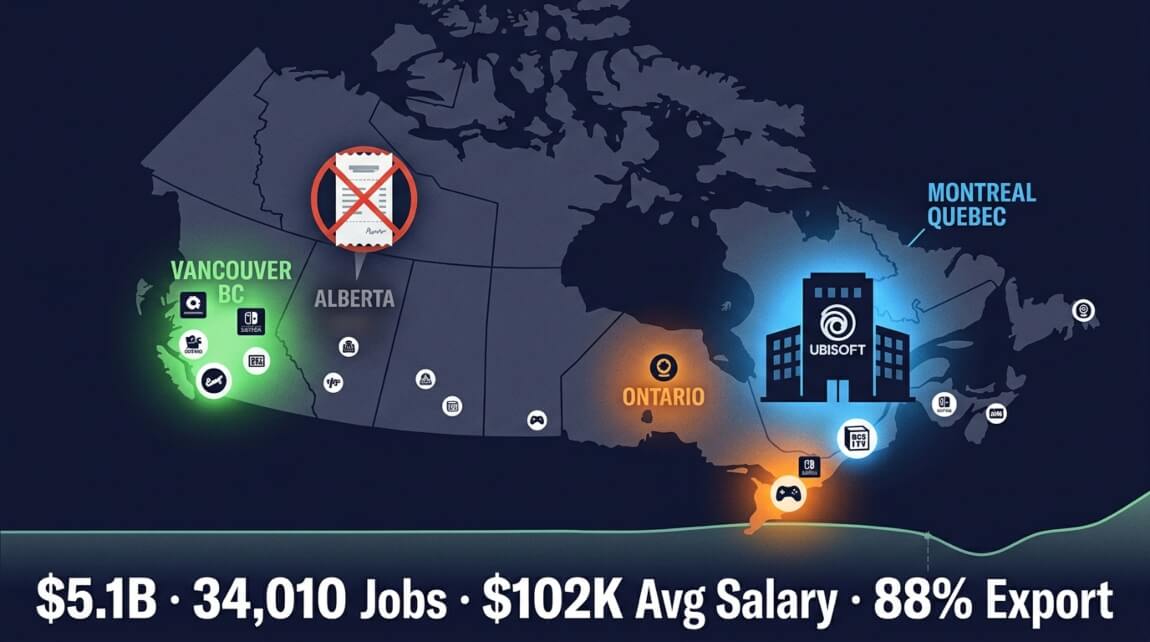
Canada’s video game industry contributed $5.1 billion to GDP in 2025. That figure comes from an economic impact study conducted by Nordicity for the Entertainment Software Association of Canada. The industry employed 34,010 people across 821 studios. Average salary: $102,000.
88% of that revenue comes from exports. Canadian studios build games that sell worldwide – Ubisoft Montreal, BioWare in Edmonton, Digital Extremes in London, Ontario. 76% of studios are Canadian-owned. But the foreign-owned companies employ 88% of the workforce. The top 25 firms account for 58% of all full-time jobs.
The geography is concentrated. Quebec has 15,220 employees across 257 studios. British Columbia: 10,930 across 146. Ontario: 6,090 across 276. Alberta has 810 people in 68 studios — and no provincial tax credit for game development, unlike Ontario, Quebec, and Nova Scotia. Alberta had one. It was cancelled.
“The video game industry is a cornerstone of Canada’s digital economy, creating high-quality jobs, driving innovation, and showcasing our creativity on the global stage.” — Paul Fogolin, President and CEO, Entertainment Software Association of Canada
The industry shrank slightly post-pandemic – a 3.5% drop in employment since 2021, driven mostly by layoffs at a few large studios and the closure of smaller ones. The number of studios fell 9% from its 2021 peak. But senior-level roles grew from 33% to 39% of the workforce, and average salaries rose 21%. The industry is getting older, more expensive, and more concentrated.
Where Gambling Sites Fit In
Somewhere between game studios and streaming platforms sits a sector that rarely gets mentioned in arts funding reports: online casino game development. Studios like Evolution, Pragmatic Play, and NetEnt employ the same kinds of people – animators, sound designers, mathematicians, UX specialists, software engineers – building products that run on the same technical infrastructure as video games.
The production pipeline for a digital slot game isn’t dramatically different from a mobile game. Visual design, mathematical modeling, QA testing, compliance certification. Live dealer studios add a broadcast layer: camera operators, lighting techs, professional presenters streaming in real time. It’s television production meets interactive software.
Canada’s relationship with this sector is complicated. Ontario launched its regulated iGaming market in April 2022, becoming the first province to allow private online casino operators to compete legally. Other provinces run online gambling through their own lottery corporations – BCLC in British Columbia, Loto-Québec in Quebec, AGLC in Alberta. The regulatory patchwork means the industry exists in Canada but doesn’t always show up in the same economic reports as other digital creative sectors.
Nobody publishes an annual GDP report on Canadian casino game development the way ESAC does for video games. The workers are counted under “software development” or “entertainment.” The creative skills are the same. The funding model is just private.
The Numbers Side by Side
Performing Arts | Video Games | |
|---|---|---|
GDP Contribution (2024) | Part of $65B arts & culture total | $5.1 billion |
Jobs | Part of 1.1M in arts & culture | 34,010 FTEs |
Avg Salary | Varies widely; many below $40K | $102,000 |
Primary Funding | Public grants + donations + tickets | Revenue from global exports (88%) |
Export Revenue | $25B in cultural goods (all sectors, 2022) | 88% of industry revenue |
Growth (3-year) | ~8% (arts & culture overall) | 3% GDP increase since 2021 |
Sources: Canadian Chamber of Commerce / Business Data Lab (Artworks report, 2025); ESAC / Nordicity (Canada’s Video Game Industry 2024); Canada Council for the Arts; Statistics Canada.
What Connects All of This
A theatre company applying for a Canada Council grant and a game studio pitching to a publisher are doing versions of the same thing: asking someone with money to bet on a creative product that doesn’t exist yet. The theatre company writes a project description and a budget. The game studio builds a prototype and a pitch deck. Both are gambling on audience attention.
The skills overlap more than either side would probably admit. Ghost River Theatre in Calgary uses projection design and real-time video in its devised productions. A casino game studio in Malta uses animation pipelines that look a lot like what Pixar ran fifteen years ago. Makambe K. Simamba, a Zambian-born playwright who started at a small Calgary theatre collective, won two Dora Awards and toured her solo show nationally – a career trajectory that has more in common with an indie game developer hitting it big on Steam than it does with a Hollywood movie star.
The difference is the money. Game developers earn $102,000 on average. Performing artists, especially in smaller markets like Calgary or Halifax, often piece together grant income, teaching gigs, and side work to clear $40,000. Both groups create content that reaches audiences, generates cultural value, and requires years of specialized training. The market just pays them differently.
Where the Money Goes Next
Budget 2025 committed $150 million over three years to Telefilm Canada, $127.5 million to the Canada Media Fund, $48 million to the Canada Music Fund, and $46.5 million to the Canada Arts Presentation Fund. The Canada Council’s budget was held steady. Cultural exports hit $25 billion in 2022 – double the 2011 figure. The top export categories: visual and applied arts, audiovisual and interactive media, written and published works.
The video game industry wants provincial tax credits in Alberta and New Brunswick, where they don’t currently exist. The performing arts want the Canada Council’s budget increased by $140 million. Online casino operators in Ontario are generating provincial tax revenue from a market that didn’t legally exist before April 2022. All three sectors are creative. All three generate economic activity. And all three are competing, in different ways, for the same pool of technical talent – animators, developers, designers, sound engineers.
The $131 billion number is real. It’s just not one industry. It’s a spectrum, running from a playwright workshopping a script in a rented rehearsal hall to a multinational studio shipping a AAA title to 40 countries. Canada has both. The question is whether it will keep funding both.